Sunday, April 26, 2009

April Bird Banding

It was an great morning of banding. We started at 6.11 a.m. and it was pleasantly cool in the canyon.
We got another Red-shafted Flicker. The person who brought it back from the net kindly handed it off to me to process. Perhaps I have made my great affection for Flickers clear?
Look how he uses his tail to brace against Walter's hand. That's what they do on trees, so he's just doing this behavior on a person for stability.
We also saw a pretty large Pacific Gopher Snake


Most birds are in breeding condition. The first bird I got was a Spotted Towhee female, who was about to lay an egg.I could tell because when I looked at her cloaca, I could see an egg-shaped bulge under the skin. As soon as I realized this I finished up with her quickly and let her go so she could make some more Towhees.

Some birds already had nestlings. Walter found these Bewick's Wren babies and showed us them:
We quickly took a peak and he put them back in the nest.

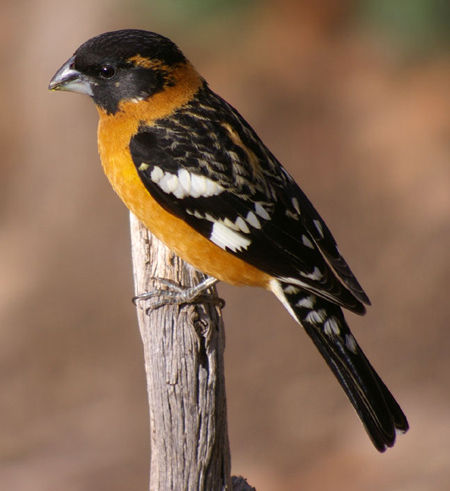
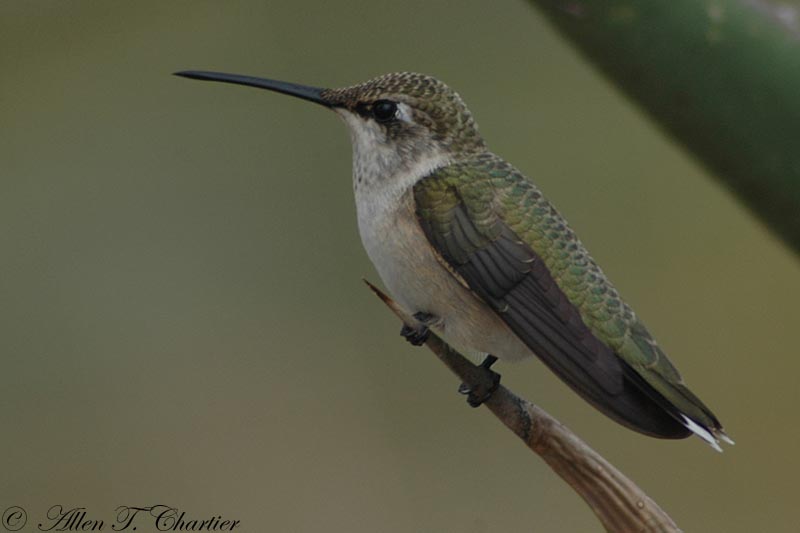
We also had a male and female Black-chinned Hummingbird, and a male and female Black-headed Grosbeak. Click on the links to look at the size of the beak. They use it. I have never been so abused by a bird. They are very good at getting tiny pieces of your finger skin in their beaks and they just clamp down. Ouch!

We also had another treat; this is an unusual bird to get in Zuma Canyon. It is quite beautiful.


Male Lazuli Bunting.

Friday, April 17, 2009

Carrizo Plain National Monument


Easier to post these here.
Tuesday, April 7, 2009

Our Very Own Birds

Two chickens and an (unexpected) quail. The quail chirps rather loudly for such a small creature. The chickens peep.

We're going to have fresh green/blue eggs in a few months!

Sunday, March 15, 2009

March Bird Banding

We had an exciting morning yesterday as we got an unusual bird. Walt has been banding in Zuma Canyon for, I think, 20 years, and he has never caught this bird. It is a rare stray to the Western U.S., and to think it landed in one of our nets!

It's the Rose-breasted Grosbeak. If you look at the range map on the right in the link, you will see it is an eastern bird, but there are records of it straying this far west.

This is a male in his winter plumage. This is his breeding plumage.
Here's Walt getting the band ready for the bird. You have to do that and hold it at the same time, which can be tricky.
Here in the west we have more commonly have the Black-headed Grosbeak.

The canyon also seemed to be suddenly flooded with singing Orange-crowned Warblers. Two weeks ago I didn't hear any, which makes me think they are migrating north right now. Though Walt says there is a resident population, too. I was really excited I heard one on a net run. I tried to find it for a while to get visual confirmation (I had heard its song and was positive, but wanted to be extra-positive about the ID). Well, I couldn't find it, but I got back to the station and said, "Walt, I know I hear an Orange-crowned Warbler." Lo and behold, one had been caught in a net already and was being processed. Old news to everyone already back at the station.
It's hard to see the orange crown in the field with binoculars. You have to have it in your hand and actually move the feathers around on his head to see it.

These plants were in bloom all over the place. It's a ribes. I think the common name is some kind of gooseberry; I'm not sure. I got this info from other people as I'm not so great at plants.

And, I was saving the daintiest for last. We got a few Anna's Hummingbirds. Here is one. I think it was a female.
Oh - and we got a few Bewick's Wrens. I love its eye stripe.

Monday, March 9, 2009

February Bird Banding + Griffith Park

I'm far behind. These pictures are from our session two weeks ago. It was kind of slow; we only had 28 birds.
One of them is this gorgeous warbler - the Common Yellowthroat. I know I've had pictures of him before, but I never get tired of his Lone Ranger look.
Here is a California Thrasher's tail. Its tail gets very beat up because they spend a lot of time in scrubby bushes.
Here I am with a male Spotted Towhee.
And here is a Hermit Thrush. They have one of the loveliest songs. I hear them when I work in Yosemite. This one is migrating north.
Wildflowers were starting to come out. Lupine.
And, some yellow flowers near Net 08.


I went on a hike in Griffith Park a week ago and wildflowers were out there, too, in the recent fire areas.


Wednesday, January 28, 2009

January Bird Banding

It rained the whole way to the coast. I didn't catch a break until somewhere in Malibu, and it didn't seem to want to hold. It was misty at Zuma Canyon, which made for a pretty slow day; we only had 26 birds total. The last two were huge treats, though. I always hear the Red-shafted Flickers calling when I am in the canyon, and this time we actually got one in a net. In fact, we hit the jackpot; we got both a male and a female.

You can see his deep red eye in the following picture (click to enlarge):


The usual Audubon's Warblers.
We caught as many of the Audubon's as we did Wrentits. This is unusual as we normally catch way more Wrentits. Maybe they were hunkered down because of the cool temperatures?

The always impressive California Thrasher, which really likes to kick. That's how they look for food, by kicking the leaf litter and uncovering tidbits to eat. Look at those feet.

Here is what the nets look like.

Sunday, January 4, 2009

Redondo Beach Pier

A little So Cal Christmas day trip to the ocean.


Brown Pelican
Brown Pelican which doesn't like the looks of me

Black-Crowned Night Heron